“In the sixth chapter of John’s Gospel the Eucharist is promised. If this chapter is read in conjunction with the accounts of the Last Supper, it is easy to see that the first Christians knew, from the very start, that the bread and wine were transformed into Christ’s actual Body and Blood.”[1]
“Scripture is either ignored or interpreted in an awkwardly metaphorical sense, as with John 6, where the Eucharist is promised….fundamentalists, contrary to popular belief, are not always literalists. This is shown in their interpretation of the key scriptural passage [regarding the Eucharist], the sixth chapter of John’s Gospel, in which Christ speaks about the sacrament that will be instituted at the Last Supper.”[2]
In John 6 “There was no attempt [by Jesus] to soften what was said, no attempt to correct ‘misunderstandings,’ for there were none. His listeners understood him quite well. No one any longer thought he was speaking metaphorically. If they had, why no correction? On other occasions, whenever there was confusion, Christ explained what he meant. Here, where any misunderstanding would be catastrophic, there was no effort to correct. Instead, he repeated what he said.”[3]
Keating uses the word warn instead of correct when in reality he is mentioning Jesus correction of the misunderstanding of His words.
Jesus “warned them not to think carnally, but spiritually: ‘Only the spirit gives life; the flesh is of no avail; and the words I have been speaking to you are spirit, and life’ (Jn 6:64)…It is here, in the rejection of the Eucharist, that Judas fell away…If they merely had misunderstood him, if they foolishly had taken a metaphor in a literal sense, why did he not call them back and straighten things out?…But he did not correct these first protesters, these proto-Protestants.”[4]
This certainly seems to contradict the rest of his teaching on this subject because in this case he is correct Jesus warned them not to think carnally, but spiritually. Indeed, they were taking the flesh and blood as literal and Jesus told them not to think carnally but spiritually, not literally but symbolically. While we do know from the text that some people turned away from Jesus due to this issue there is absolutely no indication in all of the New Testament that Judas fell away due to his rejection of the Eucharist.
“Even a rudimentary understanding of transubstantiation makes one realize that the dogma, by definition, cannot be refuted through an appeal to sensory perception since there is not supposed to be any perceptible change to the eucharistic elements.”[5]
It must be noted that if transubstantiation cannot be refuted through an appeal to sensory perception it is because the dogma has been purposefully constructed as such. In other words, the claim is that bread and wine literally transform into literal flesh and blood. An obvious response would be that when we examine the bread and wine
before and after the literal transformation takes place these elements still look, smell and taste the same. The literal transformation of the actual element produces no change at all. Therefore, the response became that while
the substance literally transforms there is absolutely no discernible change. There is no rational or scientific reason for such an obviously flawed belief. The reason is that the Vatican makes allegedly infallible proclamations only to have people notice the obvious errors and or problems within the dogma. Thereafter, the Vatican will backtrack and make various qualifications to its declaration such as claiming that a literal change is indiscernible. This is commonly noticed in various Catholic doctrines.
Keating quoting Leslie Rumble and Charles M. Carty,
“There is no logical parallel between the words ‘This is My Body’ and ‘I am the vine’ or ‘I am the door.’ For the images of the vine and door can have, of their very nature, a symbolical sense. Christ is like a vine because all the sap of my spiritual life comes from Him. He is like a door since I go to heaven through Him. But a piece of bread is in no way like His flesh. Of its very nature it cannot symbolize the actual body of Christ. And he excludes that Himself by saying, ‘The bread that I will give is My flesh for the life of the world, and My flesh is meat indeed.’ That is, it is to be actually eaten, not merely commemorated in some symbolic way.”[6]
This is a perfect example of the point we made about a dangerous lack of historical context. Rumble, Carty and Keating apparently have no idea about the details of the Passover and so they cannot comprehend how bread could symbolize Jesus, they do not even make the simple, logical and Scriptural connection between unleavened bread and Jesus’ sinless life, leaven of course is symbolic of sin, “Do you not know that a little leaven leavens the whole lump? Therefore purge out the old leaven, that you may be a new lump, since you truly are unleavened. For indeed Christ, our Passover, was sacrificed for us. Therefore let us keep the feast, not with old leaven, nor with the leaven of malice and wickedness, but with the unleavened bread of sincerity and truth” (1st Corinthians 6:6-8).
Keating retells of a debate between a Protestant and a Catholic, he explains that the protestant brought up John 6:63 and that the Catholic…
“was stunned by his use of the line, for the very good reason that in the context of the narration it can be seen not to relate to the question they were examining, which was: Is the Real Presence real?”[7]
Was the Catholic stunned that the verse was brought up because it has no relevance or because it utterly defeats the real presence doctrine. However, Keating himself employs the verse in support of transubstantiation, so why is it only when a Protestant utilizes the verse that it is a non sequitur,[8] as Keating refers to it?
Keating goes on to ridicule the clear reading of John 6:63,
Christ, who had just commanded his disciples to eat his flesh, now said their doing so would be pointless? Is that what ‘the flesh is of no avail’ means? ‘Eat my flesh, but you’ll find it’s a waste of time’—is that how he was to be understood? And were the disciples to understand that line ‘the words I have been speaking to you are spirit, and life’ as nothing but a circumlocution[9], and a fairly clumsy one at that, for ‘symbolic’? No one can come up with interpretations like these unless he first holds to the fundamentalist position and thinks it necessary to find some rationale, no matter how tortuous, for discarding the Catholic interpretation.”[10]
The charge is that the fundamentalist’s error is to take John 6 symbolically but take v. 63 literally. Keating’s response is to take John 6 literal but take v. 63 as symbolic.
Keating does explain his interpretation of the verse.
“In John 6:64 the word ‘flesh’ is not used in the same sense as in John 6:53-59. It is being used more in the Pauline sense, in which it is contrasted with ‘spirit’…Christ detects in some of his listeners an unsupernatural attitude that looks for earthly rewards and that turns away from his teaching on the Eucharist. When he says ‘the flesh is of no avail,’ he does not mean ‘my flesh’—that would contradict his immediately prior remarks. He means instead carnal understanding, as distinguished from spiritual.”[11]
Keating is constantly demonstrating that he is the one coming to the text with preconceived notions (isogesis) since he cannot allow the clear reading of the text to speak to him (exegesis) he must do what he can to explain it away although the truth comes out in the end. He admits that Christ detects…an unsupernatural attitude,
they thought that Jesus was literally speaking of His body. ‘the flesh is of no avail’…would contradict his immediately prior remarks, this is not so because Jesus is doing something that Keating denies, Jesus is correcting them, He is correcting their unsupernatural bias. He means instead carnal understanding, as distinguished from spiritual, in reality Jesus means spiritual understanding, as distinguished from carnal. If He did mean carnal understanding, as distinguished from spiritual then He would have meant ‘my flesh’ which is a carnal understanding.
“The verses fundamentalists have the hardest time with are 1 Corinthians 11:26-30…what should it be recognized as? A mere metaphor? Then how can receiving unworthily be equated with being ‘guilty of the body and blood of the Lord’?…‘…an offender against the Blessed Eucharist cannot be described as guilty of Christ’s Body and Blood, if these be not present in the Sacrament.’[12] ‘How could a person be guilty, if he had merely eaten a little bread and drunk a little wine, as a picture or representation or reminder of the Last Supper?…No one is guilty of homicide if he merely does violence to the picture or statue of a man without touching the man in person. St. Paul’s words are meaningless without the dogma of the Real Presence.’[13] They may indeed then be meaningless, but fundamentalists would rather live with a meaningless Real Absence than a meaning-full Real Presence.”[14]
Keating states “fundamentalists’ sense of the mysterious, their sense of the supernatural, that is undeveloped.”[15] But here we see that it is he himself and those he quotes in support that lack this mysterious and supernatural conception. They liken the supernatural to crumpling up a photograph or beating up a statue. In this case it seems unfitting to equate eternal justice dispensed by a perfectly righteous God to the temporal justice dispensed by finite courts. If we take their argument to a logical conclusion then we must believe that if a Jewish person (since the book Hebrews is written to Hebrews) turns away from Jesus for his salvation then they are literally forcing Jesus from His throne and back upon the cross to suffer again and again. Even though they never lay a hand on Jesus.
“For it is impossible for those who were once enlightened, and have tasted the heavenly gift, and have become partakers of the Holy Spirit, and have tasted the good word of God and the powers of the age to come, if they fall away, to renew them again to repentance, since they crucify again for themselves the Son of God, and put Him to an open shame” (Hebrews 6:4-6).
After pointing out Luke 22:19; Matthew 26:26; Mark 14:22 and 1st Corinthians 11:24, Keating admits the following, as does Associate Professor of Theology Alan Shreck.
They all translate as ‘This is my body.’ The verb estin is the equivalent of the English ‘is’ and can mean ‘is really’ or ‘is figurative.’ The usual meaning of estin is the former.”[16]
“The Old Testament predicted that Christ would offer a true sacrifice to God in bread and wine—that he would use those elements. Melchisedech, the king of Salem and a priest, offered sacrifice under the form of bread and wine (Gen 14:18).”[17]
Keating is certainly pushing the Scripture beyond what Scripture says. There is no denying that Jesus is a priest in the order of Melchizedek and that clearly there is a connection to be made between the bread and wine given to Abraham (called Abram at the time) and the bread and wine given to the Apostles. But let’s see what Genesis 14:18 says, “Then Melchizedek king of Salem brought out bread and wine; he was the priest of God Most High. And he blessed him and said: ‘Blessed be Abram of God Most High, Possessor of heaven and earth; And blessed be God Most High, Who has delivered your enemies into your hand.’ And he gave him a tithe of all.” Keating states that Melchizedek offered sacrifice under the form of bread and wine, the text does not say that, it says that he brought out or gave Abram bread and wine. While we know that Melchizedek was the priest of God Most High, we simply do not know anything about what his priesthood consisted of because this priesthood functioned before the law was given to Moses and therefore before the priesthood which the Bible so clearly describes in its many details. All we know about Melchizedek’s function as a priest is contained in Genesis 14:18. Keating is reading into the text again in order to make his (faulty) point that The Old Testament predicted that Christ would offer a true sacrifice to God in bread and wine, this we do not find in the text. The only thing we do find is that he would use those elements.
“The Mass is the renewal and perpetuation of the sacrifice of the Cross in the sense that it offers anew to God the Victim of Calvary and thus commemorates the sacrifice of the Cross, reenacts it symbolically and mystically, and applies the fruits of Christ’s death upon the Cross to individual human souls.”[18]
“The sacrifice of Calvary took place in one place only. We must look for a sacrifice apart from Calvary, one that is given under the form of bread and wine. Only the Mass meets the requirements.”[19]
Can you conceive of any worse advice to give someone than guide people to a sacrifice apart from Calvary? Yet, we can see why Keating would do this; if we cannot look to Calvary we must look to the place where Calvary is revisited and Roman Catholicism claims itself to be the only place where this takes place legitimately. Again we see how a church uses scare tactics in order to gain or keep devotes.
“How can that be? ask fundamentalists. They have to keep in mind that ‘what Jesus Christ was yesterday, and is today, he remains for ever’ (Heb 13:8). What Jesus did in the past is present to God now, and God can make the sacrifice of Calvary present to us at Mass. ‘So it is the Lord’s death you are heralding, whenever you eat this bread and drink this cup, until he comes’ (1 Cor 11:26).”[20]
Webster’s, 1983 defines Herald as “1. a royal or official messenger similar to a modern ambassador. 2. an official crier of public proclamation.” Just because we are publicly proclaiming the sacrifice does not mean that Jesus is reliving the event, that God the Father has to be reminded or that our sins are not forgiven outside of the Roman Catholic Mass.
“In the final analysis, what makes the Mass literally unbelievable for fundamentalists is that they cannot conceive of a single act that is perpetuated through time. For them, what happened on Calvary happened there alone and remains in the dead past…It is fundamentalists’ sense of the mysterious, their sense of the supernatural, that is undeveloped…they do not think of Calvary being in a perpetual Now…They are so accustomed to reading the relevant biblical verses in a particular way that they cannot see there is far more than initially meets their eyes.”[21]
Simply stated, Jesus said, “It is finished” (John 19:30) the sacrifice of Calvary is done once and for all. The proclamation of the sacrifice is perpetuated the sacrifice is not. The sacrifice that is perpetuated is explained in the Book of Hebrews, “Through Jesus, therefore, let us continually offer to God a sacrifice of praise—the fruit of lips that confess his name” (Hebrews 13:15). This is completely irrelevant to the unbloody sacrifice
of the Mass.
© 2005 Life and Doctrine. lifeanddoctrine.blogspot.com
Please feel free to copy this article in its entirety in order to store it in your computer or in order to share it with others.
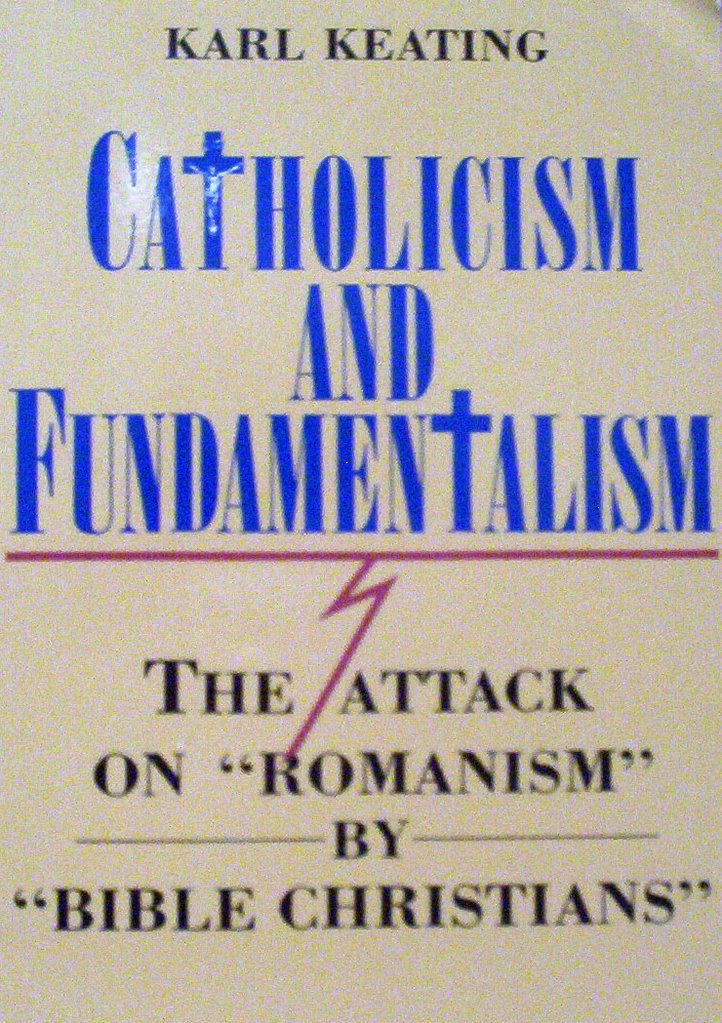
[1] Karl Keating, Catholic and Fundamentalism, The Attack on “Romanism” by “Bible Christians” (San Francisco: Ignatius Press, 1988), p. 145. Nihil Obstat: Rev. Msgr. Joseph Pollard, Censor Librorum. Imprimatur: +Most Rev. Roger Mahony, Archbishop of Los Angeles 1-28-88.
[2] Keating, pp. 188, 232
[3] Keating), pp. 233-234
[4] Keating, p. 234
[5] Keating, pp. 234-235
[6] Leslie Rumble and Charles M. Carty, Radio Replies (Rockford, Ill: TAN Books, 1979), p. 186 quoted in Keating, p.
236
[7] Keating, p. 241
[8] Non sequitur: “an inference or a conclusion that does not follow from the premise.” Webster’s, 1983
[9] Circumlocution: “a roundabout way of speaking.” Webster’s, 1983
[10] Keating, p. 242
[11] Keating, p. 242
[12] “Nicholas Wiseman, Lectures on the Real Presence, p. 319”
[13] “Leslie Rumble and Charles M. Carty, Eucharist Quizzes to a Street Preacher (Rockford, Ill.: TAN Books, 1976), 7-8”
[14] Keating, pp. 244-245
[15] Keating, pp. 256-258
[16] Keating, p. 247
[17] Keating, p. 253
[18] O’Brien, Faith, p. 304 quoted in Karl Keating; Director of Catholic Answers, a Catholic apologetics organization, Catholic and Fundamentalism, The Attack on “Romanism” by “Bible Christians” (San Francisco: Ignatius Press, 1988), p. 248. Nihil Obstat: Rev. Msgr. Joseph Pollard, Censor Librorum. Imprimatur: +Most Rev. Roger Mahony, Archbishop of Los Angeles 1-28-88.
[19] Keating, p. 254
[20] Keating, p. 256
[21] Keating, pp. 256-258